Discover in 90 seconds how LabThunder revolutionizes your laboratory management

Watch the explainer video now

Universities · Research Institutes · Shared Labs

The postdoc leaves.The equipment knowledge
goes with them.
In research labs, staff turn over every 2-5 years. Complex equipment runs for 30+ years. The knowledge of how to properly operate it disappears with every graduation, every job change, every end of semester. LabThunder preserves that knowledge so the next PhD student doesn't have to start from zero.
Thunder Molecule
WALDNER Holding SE & Co. KG
Johannes Gutenberg Universität Mainz
Zentrallabor Witowski
Life science
Chiracon
Startup Elevator
Antec
Schimadzu
SCAT
Knauer
GMP/GLP
ISO 15189
ISO 17025
Everyday research life · Typical situations

Five situations every
research lab knows.

„Dr. Müller ran all the GC-MS measurements for four years. She knew every trick of the equipment. Last week, she started her new job.
The new PhD student now stands in front of a device he doesn't understand
and the manual from 2003 doesn't help."

The last postdoc took the knowledge with them

In research labs, staff turn over every 2-5 years. Bachelor's, master's, PhD, postdoc - everyone eventually leaves, and with each departure, equipment knowledge that was never formally documented leaves too. The successor's onboarding time: 3-6 months. Often longer.
Knowledge loss · Onboarding · Staff turnover
„The HPLC system has been running since 1998. The original manual has been missing since 2010. The professor who acquired it has retired. Nobody knows how to properly configure method 7, except the senior technician, who's retiring next month."

30+ year old equipment with no living documentation

Universities rarely buy new equipment. An HPLC from 1998, a GC-MS from 2003, an NMR from 2007 - all still in use. The original knowledge disappeared long ago. What remains: the equipment, and nobody who truly knows how it works.
Aging equipment · Lost knowledge · University budget
„Three PhD students have booked the HPLC for Monday - each spoke with the others, but nobody made a central reservation. Monday, 8am: all three show up at the device.
The publication deadline: the day after tomorrow."

Booking chaos over shared equipment

Shared instrument facilities with 100+ users and 15-20 pieces of equipment need a functioning booking system. Without one: double bookings, disputes, wasted instrument time, and PhD students unable to finish their experiments on time.
Booking conflict · Shared lab · Resource planning
„Grant application: €280,000 for a new mass spectrometer. Requirement: proof of the existing device's utilization and usage statistics.

The data? Somewhere in handwritten logbooks, scattered across different folders, unusable for analysis."

Grant application with no usable equipment data

DFG, NSF, EU Horizon - all of them want usage proof for existing equipment, utilization statistics, and justifications for new acquisitions. Anyone without this data in digital, analyzable form loses out on funding or has to work with estimates.
DFG application · Usage proof · Third-party funding · NSF
„The equipment logbook only gets filled in when the professor explicitly reminds people. PhD students see it as bureaucracy that distracts from the actual research. When the technician comes to service the device, they find: no entry in six weeks. What happened during that time? Nobody knows.
Was ist in dieser Zeit passiert? Niemand weiß es."

Documentation as a tedious obligation - not a tool

Academic labs lack the external compliance pressure that forces documentation in pharma or ISO-accredited labs.

The result: logbooks are kept sporadically, errors go undocumented, solutions get lost.LabThunder flips this around: entries happen because they immediately benefit the PhD student - they see the equipment history, the last error, the next maintenance date.

Documentation becomes a tool instead of an obligation - and the equipment knowledge stays in the lab, even when the postdoc leaves.
Motivation · Adoption · Knowledge retention · Research efficiency
The real problem
Every departure comes at a cost.
3 - 6 months of onboarding time.
For a typical research laboratory with 10–15 employees and an average of 3–4 staff changes per year, this means:Up to 2 years of onboarding time that produces no measurement results.LabThunder drastically reduces this because the knowledge remains in the system.
3 - 6
Months of onboarding per person
30+
Years of equipment without documentation
83%
Dependent on individual employees
The Solution · LabThunder for Academia

Knowledge that stays.
No matter who leaves.

LabThunder turns equipment knowledge into a laboratory asset not the personal property of individual scientists. When a postdoc leaves, their knowledge stays in the system.
A living equipment wiki—left behind by postdocs

SOPs, troubleshooting tips, and device-specific hacks, documented right at the machine and ready for the next user. Outgoing postdocs pass on their knowledge in a structured way, and new PhD students find exactly what they need, instantly.

Thunder Wiki
Knowledge Transfer
Onboarding
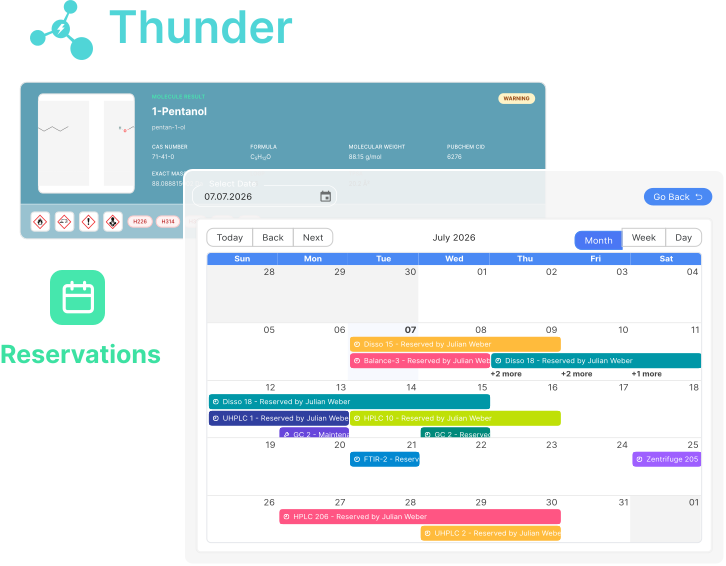
Booking calendar for shared instruments

Book all your equipment centrally—online, from your smartphone, and in real time. Say goodbye to double bookings, scheduling conflicts, and unfair resource distribution. You can even assign specific time slots to external users.

Shared Lab
Booking
No conflict
QR code on the device - instant access to all information

Scan → instant access: user manuals, recent errors, maintenance history, who last used the device, and what was done. For a 30-year-old HPLC just as easily as for the latest mass spectrometer.

QR-Code
Instant access
Usage statistics for DFG & third-party funding

Capacity utilization, hours of use per device, user groups – automatically tracked and ready for instant export. Applying for new equipment via the DFG? The data is ready, actionable, and compelling.
DFG funding acknowledgement
Capacity
Lab Insights
Thunder AI - Your virtual senior technician

AI trained on all of the laboratory's manuals, SOPs, and error logs. "How do I configure method 7 on the HPLC?" – Get answers from your own knowledge base, not the internet. Even for equipment that has been running since 1998.

Thunder AI
Troubleshooting
24/7
Maintenance & Calibration - never forget again

All maintenance intervals are monitored automatically, with reminders sent well in advance. Service visits are fully documented. For equipment designed to run for 30 years, a complete maintenance history is worth its weight in gold—and helps prevent costly downtime.

Maintenance intervals
Reminder
Service history
70%
less documentation time
10 wo.
until full rollout
30 min
Team onboarding
96%
User satisfaction
Discover in 90 seconds how LabThunder revolutionizes your laboratory management

Watch the explainer video now

Close Cookie Popup
Cookie Einstellungen
Mit Klick auf "Alle akzeptieren", stimmst du der Speicherung von Cookies auf deinem Gerät zu, um die Navigation auf der Website zu verbessern, die Nutzung der Website zu analysieren und unsere Marketingaktivitäten zu unterstützen. Mehr Infos
Essentielle Cookies (Immer aktiviert)
Cookies, die erforderlich sind, um grundlegende Funktionen der Website zu ermöglichen.
Cookies, die helfen zu verstehen, wie diese Website funktioniert, wie die Besucher mit der Website interagieren und ob es möglicherweise technische Probleme gibt.
Cookies, die verwendet werden, um Werbung zu liefern, die für Sie und Ihre Interessen relevanter ist.
Cookies, die es der Website ermöglichen, die von dir getroffenen Entscheidungen zu speichern (z. B. deinen Benutzernamen, deine Sprache oder die Region, in der du dich befindest).