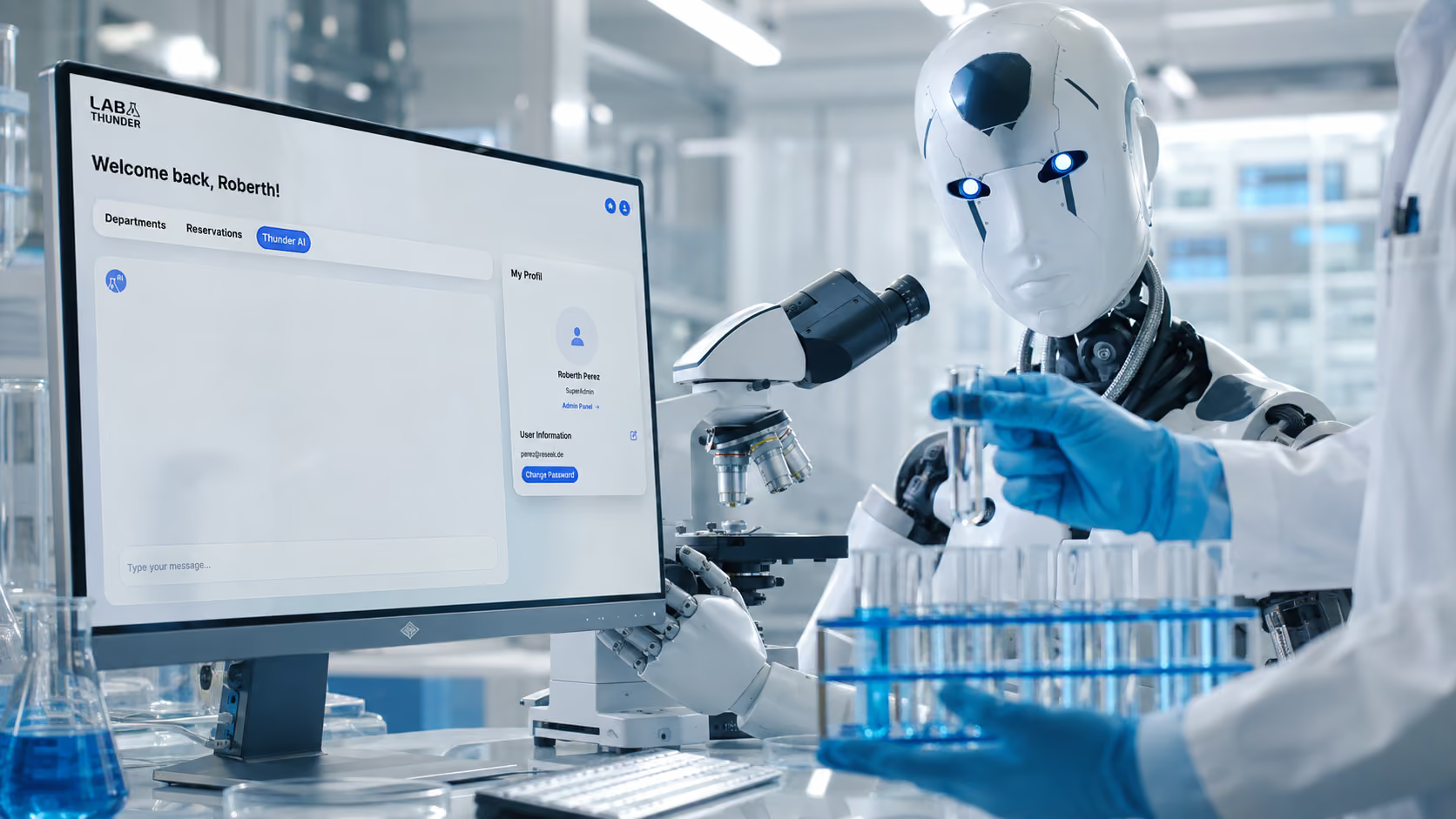
Modern Lab Administration: How Laboratories Cut Costs and Stay Ahead of the Competition
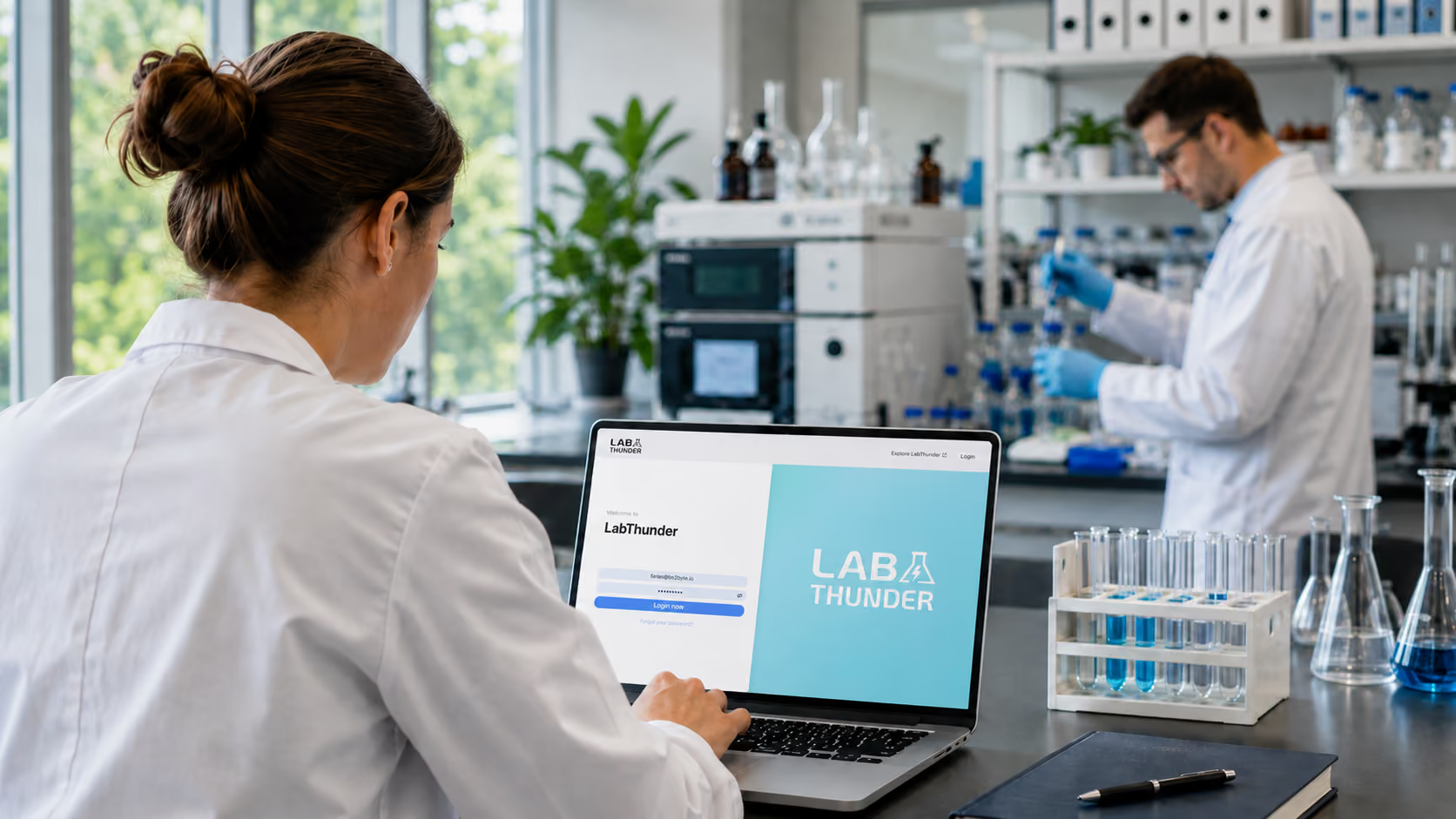
In short: Modern lab administration is the digital management of every organizational lab process – from equipment logbooks to knowledge management and QM documentation – through a single platform instead of paper and scattered spreadsheets. It cuts costs, protects know-how and keeps labs audit-ready. Platforms like LabThunder follow a modular principle: several specialized tools that talk to each other, rather than one bloated monolith.
Margins in the lab business are getting thinner. Reagents, energy, staff – costs climb on every front, while competitors get faster and cheaper. At the same time the market is consolidating: larger providers acquire smaller ones and use economies of scale to push prices down. To keep up, you can no longer afford inefficient workflows. This is exactly where modern lab administration comes in.
The gap between a lab still running on handwritten logbooks and a pile of spreadsheets, and one that manages its processes digitally, is no longer a technical detail. It's a competitive factor.
What Modern Laboratory Administration Means Today
Laboratory administration covers all the organizational tasks that keep a lab running: maintaining and calibrating equipment, recording events in logbooks, managing inventory, documenting knowledge and meeting the requirements of standards such as ISO 17025 or GxP.
Traditionally this ran on paper binders, local files and the knowledge held by individual staff members. That works – until someone is out sick, a spreadsheet circulates in the wrong version, or an auditor asks for a record no one can find on the spot.
Modern laboratory management moves these tasks into a single platform. All information sits in one place, versioned, searchable and available to authorized people at any time. That's the core: not digitization for its own sake, but a system in which processes run in a traceable, repeatable way.
From Paper and Spreadsheets to Laboratory Digitalization
Spreadsheets are everywhere in the lab – and that's the problem. They're flexible, but that's exactly what makes them a source of error. Formulas get overwritten, versions drift apart, and in the end no one knows which file is the current one.
Laboratory digitalization means closing this gray zone. Instead of parallel files, there's one source of truth. Instead of "who changed this last?", there's a complete audit trail. Instead of a dusty paper logbook next to the instrument, there's a digital entry that's instantly findable.
The switch is overdue, because the hidden costs of the status quo are high: time lost searching and asking around. Errors that surface too late. And the risk of failing an audit because the documentation isn't complete.
Digital Logbooks: No More Paper Next to the Instrument
The equipment logbook is one of the most underrated documents in the lab. Who performed which maintenance, and when? When was the last calibration? What fault occurred, and how was it resolved? Traditionally this lives in a binder next to the instrument – handwritten, hard to read and, at audit time, often incomplete.
A digital logbook solves this at the root. Every entry is timestamped, tied to a user and logged so it can't be altered. Maintenance intervals send automatic reminders before an instrument drifts out of tolerance. And when the auditor asks for an instrument's history, it's there in seconds – complete and ALCOA+ compliant.
Logbooks like these are among the building blocks that relieve a lab quickly and visibly. The benefit is immediate, without having to overhaul the entire lab at once.
Knowledge Management: Securing Know-How Before It Walks Out the Door
The biggest hidden weakness in many labs is that critical knowledge exists only in people's heads. The colleague who knows exactly how the old HPLC system reacts to a particular error. The technician who knows the trick that makes a method run reproducibly. When that person leaves, the knowledge goes with them.
Knowledge management in the lab means getting that know-how out of people's heads and into the system: SOPs, test instructions, troubleshooting notes, best practices – central, versioned and searchable. New employees find answers themselves instead of constantly asking. And the knowledge stays in the lab, even when someone leaves.
This is where AI-assisted search really pays off. AI in the lab can pull the right instruction from thousands of documents in seconds and deliver it with a source reference, instead of someone leafing through binders for minutes. That's not hype – it's simply saved time on a task that comes up constantly.
Modular Instead of Monolithic: The Advantage of Tools That Communicate
Traditional laboratory software often ships as one large system that tries to do everything – and in practice does much of it only half well. You pay for features you never use and fight an interface made cluttered by its own scope.
The more modern approach is modular. Instead of a monolith, you rely on specialized tools that each do one thing really well – and that talk to each other. One module for logbooks, one for knowledge management, one for chemical inventory. Each one lean and focused on its own, together a seamless system.
This is exactly the principle behind LabThunder: an ecosystem of specialized modules that exchange data through a shared platform. The advantage is twofold. First, each module gets the best out of its specialized solution instead of making the compromises of an all-in-one. Second, you start small – with the module that solves the biggest pain – and expand when it fits. No risky big-bang migration, no investment in features you won't need for years.
That's the decisive difference from a large, rigid system: two small tools that talk to each other cleanly beat a giant tool that does everything and nothing well.
Cutting Costs and Gaining Efficiency – the Concrete Levers
The business case for modern lab administration stands or falls on the hours saved. A rough example calculation (order of magnitude, not an exact figure):
Suppose five staff members each lose 30 minutes a day searching for documents, filling in paper logbooks and asking around. That's 2.5 hours a day, roughly 600 hours a year. At an assumed rate of $40 an hour, that's on the order of $24,000 a year – from avoidable search effort alone.
On top of that come effects that are harder to quantify but real:
- Lower audit risk, because logbooks and records are always complete and on hand.
- Secured knowledge that doesn't leave the lab with individual employees.
- Faster onboarding, because answers live in the system instead of only in people's heads.
- Less material waste through monitored expiry dates and inventory.
The point isn't to cut staff. The point is that the same team gets more done – and that's exactly what decides things under competitive pressure.
What to Look for When Choosing Laboratory Software
Not every laboratory software fits every lab. This checklist helps:
- Modularity: Can you start small and expand, or do you have to roll out the whole system at once?
- Fit with daily lab work: Does the software map your real processes, or do you have to bend to the software?
- Regulatory support: Does it cover the standards relevant to you (ISO 17025, GxP, ISO 9001), with a complete audit trail and ALCOA+?
- Usability: Will the team actually adopt it, or drift back to spreadsheets after three weeks? Adoption decides your ROI.
- Data ownership and support: Where does your data live, and how fast do you get help when something breaks?
A common mistake is to look only at feature count. What matters is whether the team actually uses the solution day to day.
Conclusion: Lab Administration as a Competitive Edge
Rising costs and a tougher market leave labs little room. Modern lab administration is the lever to absorb that pressure – not through spectacular technology, but through processes that run reliably, traceably and efficiently.
Getting started doesn't have to be a big project. A modular approach like LabThunder's lets you begin with the building block that eats the most time – often the equipment logbook or knowledge management – and expand from there. What matters is starting at all. Because the competitors already working digitally aren't waiting.
Recommendation: Analyze where in your lab the most time goes into administration rather than analysis. That bottleneck is the best starting point – and with a modular system, exactly the first module you roll out.
FAQ
What is lab administration?
Lab administration covers all the organizational tasks that run a laboratory: equipment logbooks, maintenance, inventory and knowledge management, and compliance with regulatory requirements. Modern lab administration bundles these tasks into a single platform instead of paper binders and spreadsheets – traceable, versioned and audit-ready.
What does a digital logbook do for a lab?
A digital logbook replaces handwritten equipment records with timestamped, user-bound and tamper-proof entries. Maintenance and calibration dates trigger automatic reminders, and at audit time the full instrument history is available in seconds. This reduces errors, saves search time and meets data-integrity requirements such as ALCOA+.
Why is knowledge management in the lab important?
Because critical know-how often exists only in individual heads and leaves the lab with those employees. Knowledge management brings SOPs, test instructions and experience-based knowledge into the system – central, versioned and searchable. New staff find answers themselves, and the lab stays operational even when people change.
Is modular laboratory software better than one large all-in-one system?
Often, yes. A modular approach of specialized tools that communicate gets the best out of each task instead of making the compromises of an all-in-one. You can start small, pay only for what you use and expand step by step – without a risky full migration. LabThunder is built on exactly this principle.
Does AI in the lab replace employees?
No. AI in the lab mainly takes on routine and search tasks – such as finding the right documents or instructions with a source reference. Professional judgment and regulatory decisions stay with qualified staff. The benefit is that employees spend less time searching and more on demanding work.
How do you best get started with modern lab administration?
Best to begin with the process that costs the most time – often the equipment logbook or knowledge management. You digitize that area first, gain experience and expand from there. A modular system like LabThunder makes exactly that possible: start small, extend when needed, without overhauling the whole lab at once.
enen Monolithen.
Die Margen im Laborgeschäft werden dünner. Reagenzien, Energie, Personal – die Kosten steigen an jeder Ecke, während der Wettbewerb schneller und günstiger wird. Gleichzeitig konsolidiert der Markt: Größere Anbieter kaufen kleinere auf und drücken über Skaleneffekte die Preise. Wer da mithalten will, kann sich ineffiziente Abläufe nicht mehr leisten. Genau hier setzt moderne Laborverwaltung an.
Der Unterschied zwischen einem Labor, das noch mit handschriftlichen Logbüchern und einer Sammlung an Excel-Tabellen arbeitet, und einem, das seine Prozesse digital steuert, ist kein technisches Detail mehr. Es ist ein Wettbewerbsfaktor.
Typische Fragen zum Moderne Laborverwaltung
Was ist Laborverwaltung?
Laborverwaltung umfasst alle organisatorischenAufgaben, die den Laborbetrieb steuern: Gerätelogbücher, Wartung, Bestands- undWissensmanagement sowie die Einhaltung regulatorischer Vorgaben. ModerneLaborverwaltung bündelt diese Aufgaben in einer zentralen Software statt inPapierordnern und Excel-Listen – nachvollziehbar, versioniert und auditsicher.
Was bringt ein digitales Logbuch im Labor?
Ein digitales Logbuch ersetzt handschriftliche Gerätebücher durch zeitgestempelte, nutzergebundene und unveränderbare Einträge. Wartungs- und Kalibriertermine erinnern automatisch, und bei einem Audit liegt die vollständige Gerätehistorie in Sekunden vor. Das reduziert Fehler, spart Suchzeit und erfüllt Anforderungen wie ALCOA+ an die Datenintegrität.
Warum ist Wissensmanagement im Labor wichtig?
Weil entscheidendes Wissen oft nur in einzelnen Köpfen existiert und mit diesen Mitarbeitern das Labor verlässt. Wissensmanagement holt SOPs, Prüfanweisungen und Erfahrungswissen zentral, versioniert und durchsuchbar ins System. Neue Mitarbeiter finden Antworten selbst, und das Labor bleibt handlungsfähig, auch wenn Personal wechselt.
Ist eine modulare Laborsoftware besser als ein großes Gesamtsystem?
Häufig ja. Ein modularer Ansatz aus spezialisierten Tools, die miteinander kommunizieren, holt aus jeder Aufgabe das Beste heraus, statt die Kompromisse eines Alleskönners zu machen. Man kann klein anfangen, nur für Genutztes zahlen und schrittweise ausbauen – ohne riskanten Komplettumstieg. LabThunder setzt genau auf dieses Prinzip.
Ersetzt KI im Labor Mitarbeiter?
Nein. KI im Labor übernimmt vor allem Routine- und Suchaufgaben – etwa das Auffinden passender Dokumente oder Anweisungen mit Quellenangabe. Fachliche Bewertung und regulatorisch relevante Entscheidungen bleiben beim qualifizierten Personal. Der Nutzen liegt darin, dass Mitarbeiter weniger Zeit mit Suchen und mehr mit anspruchsvollen Aufgaben verbringen.
Wie startet man am besten mit moderner Laborverwaltung?
Am besten mit dem Prozess, der am meisten Zeit kostet – oft das Gerätelogbuch oder das Wissensmanagement. Diesen Bereich digitalisiert man zuerst, sammelt Erfahrung und baut von dort aus. Ein modulares System wie LabThunder macht genau das möglich: klein starten, bei Bedarf erweitern, ohne das ganze Labor auf einmal umzustellen.