
AI in the Laboratory: How to Use Artificial Intelligence Effectively
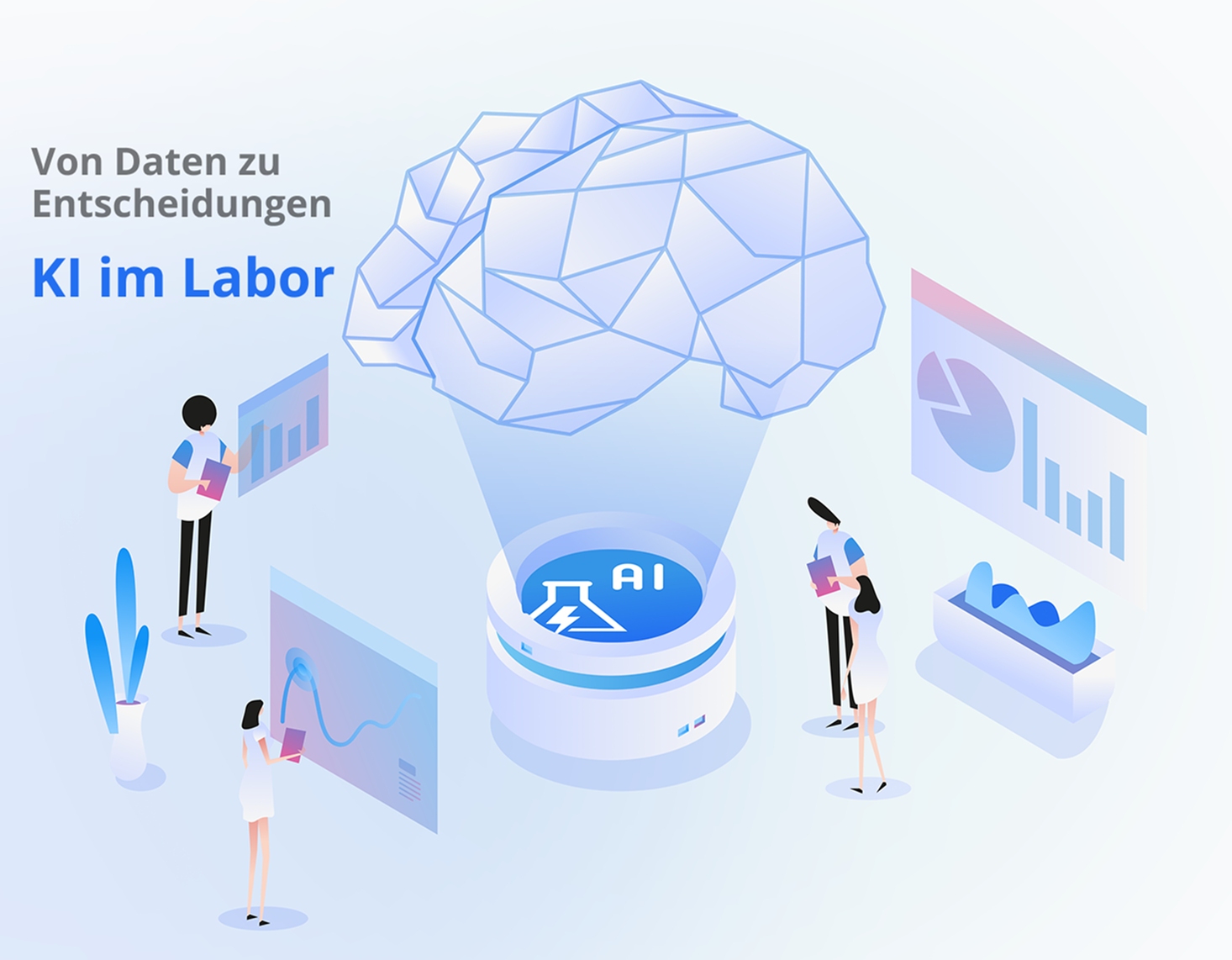
SImagine: You can find any procedure in your lab in seconds. You can troubleshoot equipment malfunctions without having to wade through 200-page manuals. What sounds like science fiction is already a reality. Digitization through artificial intelligence is already transforming work in modern laboratories.
Why laboratories now need to digitize
Modern laboratories face growing challenges: more equipment, more data, more documentation requirements. Despite all efforts, many institutions are still dependent on:
- Experienced technicians who "know everything"
- Scattered manuals in shared folders
- Handwritten notes that no one can find again
- Isolated systems without interfaces
- Knowledge that disappears when employees leave.
The result:Time wasted searching for information, duplicated work, and decisions made without a complete data basis. This is where AI comes in and makes the crucial difference.
[[image-1]]
Five areas where AI offers real added value
1. Technical documentation at the touch of a button
No more tedious searching through numerous documents. AI systems can:
- Identify and understand manuals, SOPs, and records
- Answer technical questions in seconds
- Linking information from different sources
- Provide exact source information
Practical example:Instead of opening five PDFs, ask a simple question and receive the exact answer with a reference to the official document.
2. Intelligent device management
Every piece of laboratory equipment continuously generates data. AI analyzes these patterns and can:
- Detect unusual readings early
- Identify anomalous device behavior
- Warning about critical trends
- Suggest preventive maintenance
The AI observes the historical behavior of your devices and can predict what might happen next.
3. Your personal technical assistant
An AI solution offers 24/7 support:
- Knows the entire laboratory documentation
- Remembers every past incident
- Knows the history of every device
- Guides you step-by-step through complex procedures
Important: AI does not replace your judgment, but provides the right information at the right time.
4. Automation of routine tasks
AI reliably handles repetitive tasks without a creative component:
- Document classification
- Data extraction from records
- Examination of basic criteria
- Filling out standard forms
This will free up time for truly important activities.
5. Standardization of workflows
AI helps when there are different levels of experience within a team, shift work, or high turnover:
- Training new staff
- To remember critical points
- to enforce best practices
- To reduce errors caused by forgetting
How AI works in the lab
AI is neither magic nor an opaque black box. It combines three key abilities:
Understands technical language:The AI learns the specific terminology of your laboratory – units of measurement, abbreviations, chemical concepts and normative references.
Linked information:While a human needs time to compile logs, manuals, calibrations, and maintenance reports from different systems, AI does this in milliseconds.
Think in context:When faced with the question "Why is the HPLC baseline unstable?", the AI checks historical patterns, consults technical notes, analyzes previous interventions and suggests likely causes – based on your lab's data.
Three practical use cases
Case 1: Rapid Problem Solving
Previously:The device displays an error message. You consult the manual, call colleagues, and contact customer service. Lost: half a day.
What OUT:The system responds in seconds: "Error E-104 occurred three times in the last 60 days. In all cases, it was resolved by restarting the lamp module and checking the nitrogen flow."
Case 2: Immediate access to information
Previously:You need the stabilization time of your HPLC. Where was that documented? In the manual? In the SOP? In an email?
What OUT:"According to SOP-HPLC-02, section 4.3: The system requires 20-30 minutes of stabilization time before injection."
Case 3: Automated Training
Previously:New staff, different interpretations of the same procedures, variability between shifts.
What OUT:The system provides real-time guidance: "Don't forget to flush the valve and check the vial volume before starting the injection."
Limits and risks: The honest perspective
AI is powerful, but not perfect. You should be aware of these limitations:
No autonomous decisions:AI makes suggestions and analyzes, but should never independently interpret test results, authorize product releases, or validate analytical reports. Your judgment always has the final say.
Dependence on data quality:AI reflects inconsistencies in incomplete logs or outdated manuals. The solution: Keep your data up-to-date and complete.
Potential for errors:Even the best systems can misinterpret questions or confuse concepts. Always validate critical decisions yourself. AI is your copilot, not your autopilot.
Security and Compliance
In regulated environments, these security aspects are indispensable:
- Complete data isolation between customers
- Your data will not be used for public models.
- European infrastructure operated under EU control
- Encryption during transmission and storage
- Role-based access control
For GMP, ISO 17025 and ISO 15189, every action must be traceable. Professional AI solutions integrate into these compliance frameworks.
The paradigm shift: From data to knowledge
Traditional laboratory software records data, generates reports, and fulfills audit requirements. AI transforms your system into a knowledge platform that interprets, links, and delivers information at the right time.
Labs with well-implemented AI report:
- Drastic time savings when searching for information
- Fewer operational errors
- Faster and more informed decisions
- More autonomous staff with less dependence on individual experts
- Better use of the collected knowledge
Conclusion: Reinforce, don't replace
The promise of AI in the lab is not to replace your team, but to multiply its capabilities. Experienced employees focus on complex problems, while AI handles routine tasks. New staff become productive from day one. Years of accumulated experience are transformed into knowledge accessible to everyone.
The laboratory of the future does not automate everything – it integrates intelligence where it is most needed.

.png)