
Digital Technical Logbooks in the Laboratory – Why Every Laboratory Needs Them Today
.avif)
The logbook in everyday laboratory work – useful, necessary, but limited
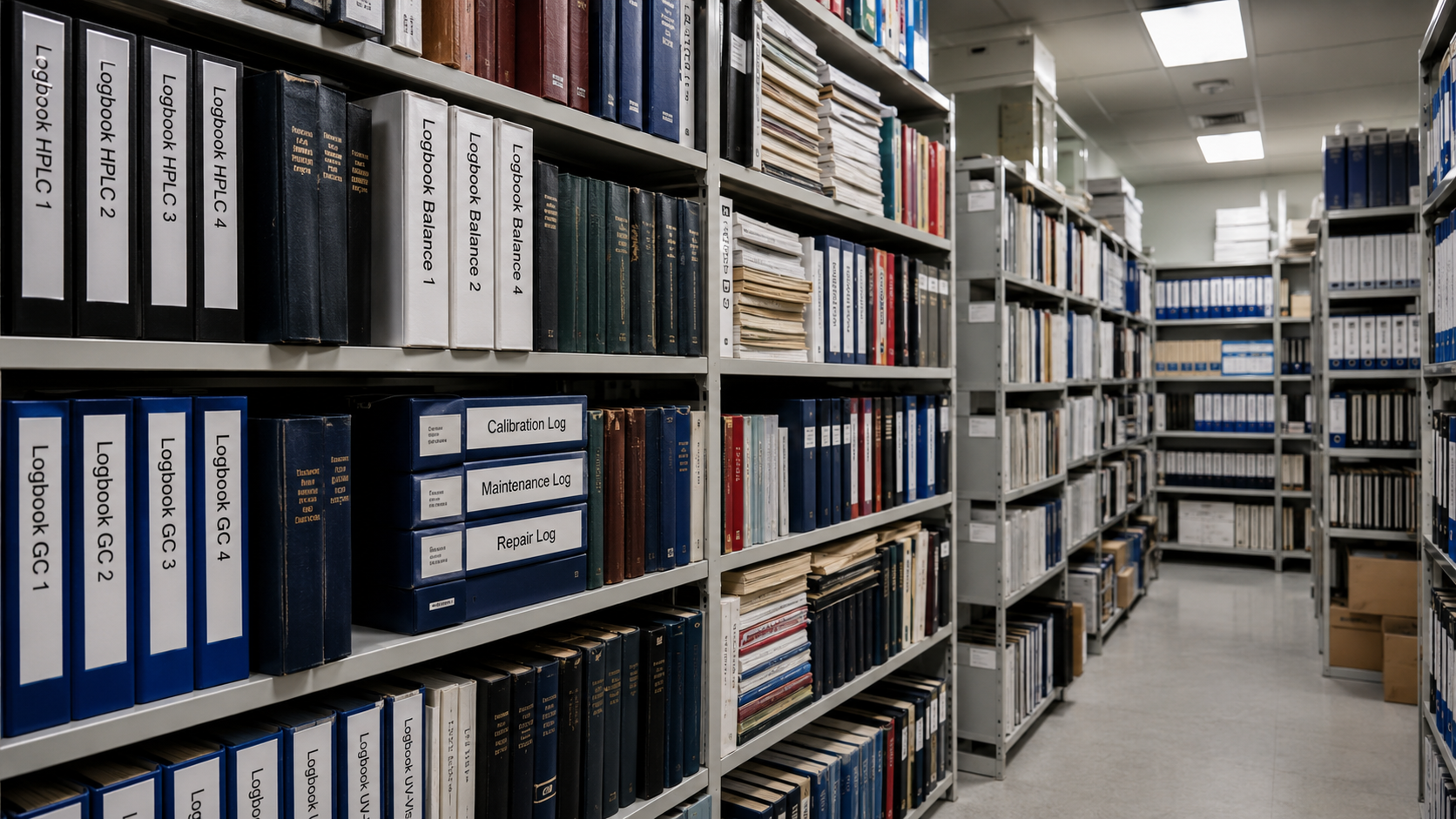
Who isn't familiar with it? The logbook – a notebook, folder, or bound book – right next to, above, or on top of the lab equipment. It records who worked on the device, what measurements were taken, whether maintenance was performed, what error occurred, and how it was resolved.
This practice makes sense. It creates transparency regarding device usage, supports the traceability of measurement results, and forms the basis for quality assurance. At the same time, it is a regulatory requirement: Standards such as DIN EN ISO/IEC 17025, DIN EN ISO 15189, as well as requirements from GMP and GLP environments, demand traceable and complete documentation of device use throughout its entire lifecycle.
This is precisely where the core problem begins. These notebooks, books, and folders contain valuable knowledge about equipment and processes – knowledge that is urgently needed in everyday practice but is practically unusable. It is difficult to read, not searchable, not analyzable, not linkable, and therefore inaccessible to automation or AI in the lab. What should actually be a central knowledge tool becomes a passive archive.
Typical problems of traditional paper-based logbooks
The weaknesses of classic logbooks are not theoretical constructs, but rather lived laboratory practice:
Handwritten entries are often difficult or impossible to read. Content is documented inconsistently – depending on the person, their mood, and time constraints. Mandatory information is missing, pages are damaged or lost. Logbooks are stored on the device but are not centrally accessible, especially not across locations or departments.
A structured error history does not exist. Maintenance, repairs, calibrations, and deviations are recorded separately without any systematic connection. Service reports, calibration certificates, and validation protocols are stored separately – in folders, email inboxes, or file systems. In the event of an audit, the relationship between the logbook, maintenance, calibration, and device status must be manually reconstructed.
Knowledge loss during staff turnover is particularly critical. Experiential knowledge disappears with employees, even if it is formally documented. The audit effort increases continuously because information has to be searched for, compared, and validated.
What is a logbook – and why is it mandatory?
A logbook in the laboratory serves to comprehensively document all equipment-related events. This includes usage, deviations, malfunctions, maintenance, repairs, and calibrations. The goal is to be able to trace at any time the condition of a device and the conditions under which measurement results were obtained.
The regulatory framework is clear. Both DIN EN ISO/IEC 17025 and DIN EN ISO 15189 require documented monitoring of testing and measuring equipment. In GMP and GLP laboratories, the logbook is also a central element of equipment control and traceability, especially for GLP equipment that directly influences test results.
The ALCOA principle – Attributable, Legible, Contemporaneous, Original, Accurate – forms the benchmark for this documentation. Logbooks are one of the most important instruments for the practical implementation of this principle. They must be clearly attributable, legible, timely, faithful to the original, and accurate.
This makes it clear: logbooks are not a nice-to-have, but an essential component of quality assurance.
Why Excel is not a sustainable solution
Excel is used in many laboratories as a pragmatic alternative. Spreadsheets for test equipment monitoring, maintenance lists, or simple calibration overviews can be created quickly and are easily accessible. However, Excel has structural limitations.
There is a lack of true data integrity. Changes are only partially traceable, and an auditable history does not exist. Responsibilities remain unclear, as entries can easily be overwritten or copied. Versioning and copying problems are commonplace, especially when multiple people are working simultaneously.
Access control is rudimentary, and device context is lacking. Excel does not provide a consistent link between the logbook, test equipment management, measuring equipment monitoring, and test equipment calibration monitoring. Therefore, integrated test equipment management or measuring equipment management is not possible.
Excel can be helpful, but it doesn't replace logbook, test equipment, or laboratory management software. Free test equipment monitoring software can also provide occasional assistance, but it usually remains limited to specific aspects and rarely meets long-term regulatory requirements.
[[image-1]]
Digital logbooks – what is fundamentally changing
Digital logbooks not only change the medium, but also how we handle device knowledge. They enable centralized, device-specific documentation that doesn't end at the physical location of the device. Information is captured in a structured way, instead of being stored solely as free text.
A complete history is created throughout the entire device lifecycle – from commissioning and use to maintenance, calibration, and decommissioning. Digital logbooks can be directly linked to test equipment management, measuring equipment monitoring, maintenance and calibration planning, and device status.
This makes them a core component of modern laboratory digitization. In this context, laboratory digitization does not mean automation for its own sake, but rather the targeted utilization of existing information within the framework of equipment management and laboratory management software.
Document linking & integrated action chain
A key benefit of digital logbooks lies in their role as an integration layer. Logbook entries can be directly linked to relevant documents: service reports, maintenance records, calibration certificates, validation and qualification protocols such as IQ, OQ and PQ, as well as deviation or error reports.
This creates an integrated chain of action: An event is recorded, a measure is taken, the evidence is documented, and the device status is updated. This closed chain is crucial for audit-proof documentation. It meets the requirements of DIN EN ISO 17025, GMP, and GLP and consistently implements the ALCOA principle.
Media breaks are eliminated. Information no longer needs to be gathered from different systems, folders, or tables. Digital logbooks are therefore not simply digitized notebooks, but rather the central context for all device-related information.
Differentiation from paper and Excel
Paper-based logbooks can, at best, reference documents. Excel can link files, but it remains neither revision-proof, context-aware, nor audit-proof. The result is fragmented documentation, high manual effort, and an increased risk of errors – especially under audit conditions.
Digital logbooks close this gap by bringing together structure, context, and traceability.
Digital logbooks as a basis for automation and AI in the laboratory
Structured log data is a prerequisite for any form of automation in the laboratory. Only when events, conditions, and actions are consistently recorded can trends be identified, errors proactively detected, or assistance systems used effectively.
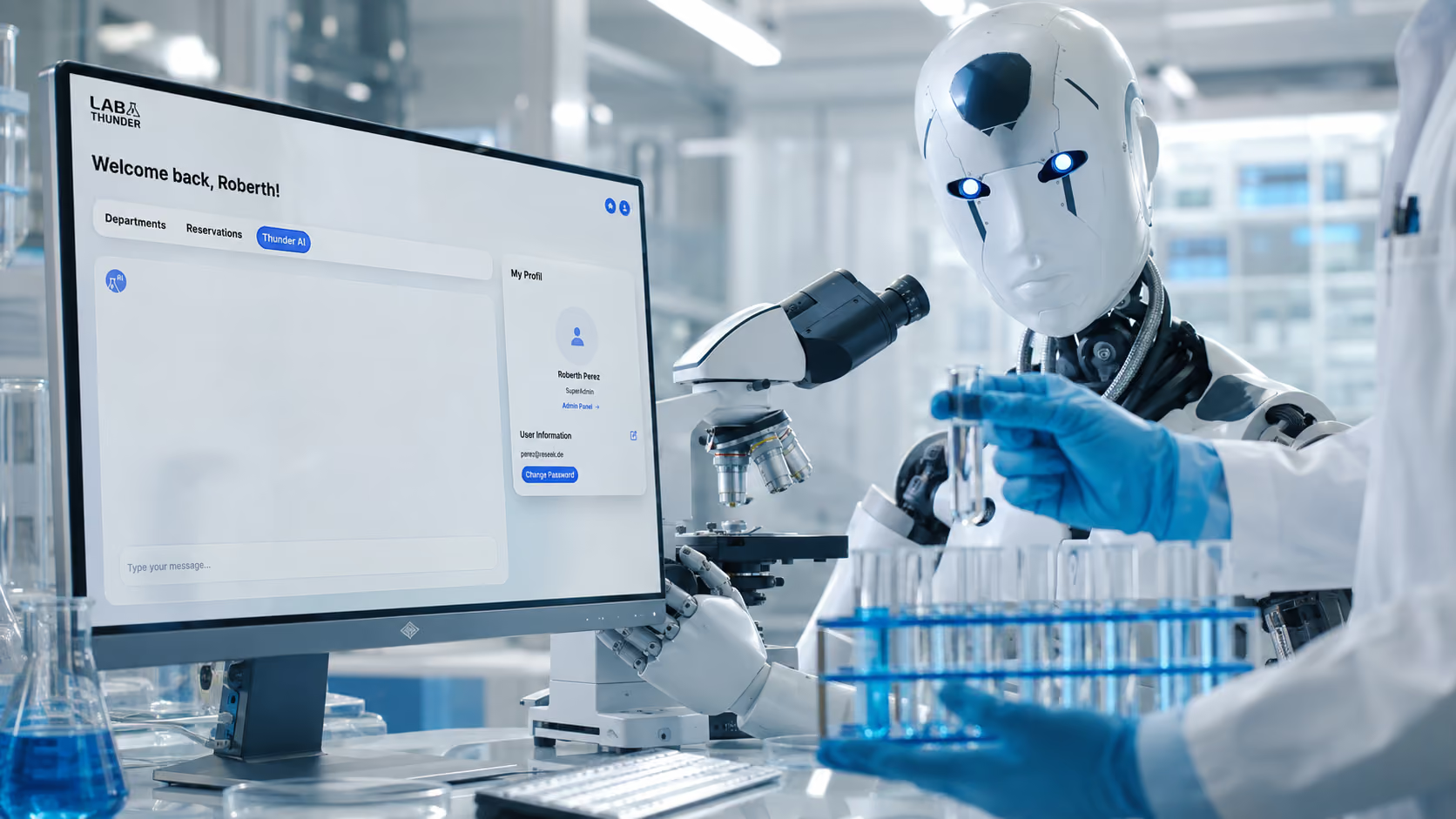
AI in the lab needs context, not unstructured text fragments. Paper and Excel spreadsheets are a dead end here. Digital logbooks, on the other hand, pave the way for lab automation without replacing existing processes. They make existing data usable and open up perspectives for data-driven decision support.
Modern laboratory management software often integrates digital logbooks directly with test equipment monitoring, test equipment management software, and device management. The crucial point is not the individual tool, but the principle: information is consolidated instead of being scattered.
Conclusion
Digital logbooks are not an IT luxury. They are the foundation for compliance, efficiency, knowledge retention, and future viability in the laboratory. Anyone who takes laboratory digitalization seriously doesn't start with AI or automation, but with the logbook – the place where instrument knowledge is generated and quality becomes measurable.
Frequently Asked Questions About Digital Logbooks in the Laboratory
Do all laboratory devices require their own individual logbook?
Yes. Device-specific documentation is required for all test and measurement equipment. This is the only way to clearly assign usage, maintenance, calibration, and deviations to a specific device, as required by DIN EN ISO/IEC 17025, DIN EN ISO 15189, and GMP and GLP standards.
Is a maintenance report sufficient without a logbook?
No. A maintenance log documents individual actions, but it does not replace a logbook. Only a logbook establishes the complete connection between usage, equipment status, maintenance, calibration, and deviations, ensuring full traceability.
How detailed do logbook entries need to be?
Logbook entries must be detailed enough for a qualified third party to reconstruct the process. This includes the time, the person responsible, the nature of the event, the measures taken, and—where relevant—the impact on device status or measurement results. While unnecessary details should be avoided, clarity is essential.
What role do digital logbooks play in audits?
Digital logbooks significantly reduce audit efforts. Information is structured, complete, and directly linked to maintenance, calibration, and service documents. Auditors can verify relationships more quickly without having to rely on manual reconstruction.
Is the introduction of digital logbooks worthwhile for smaller laboratories too?
Yes. Smaller laboratories in particular benefit from clear structures, reduced documentation efforts, and improved knowledge retention. Digital logbooks help you work in compliance with standards while using limited resources and reducing dependency on individual staff members.


.avif)