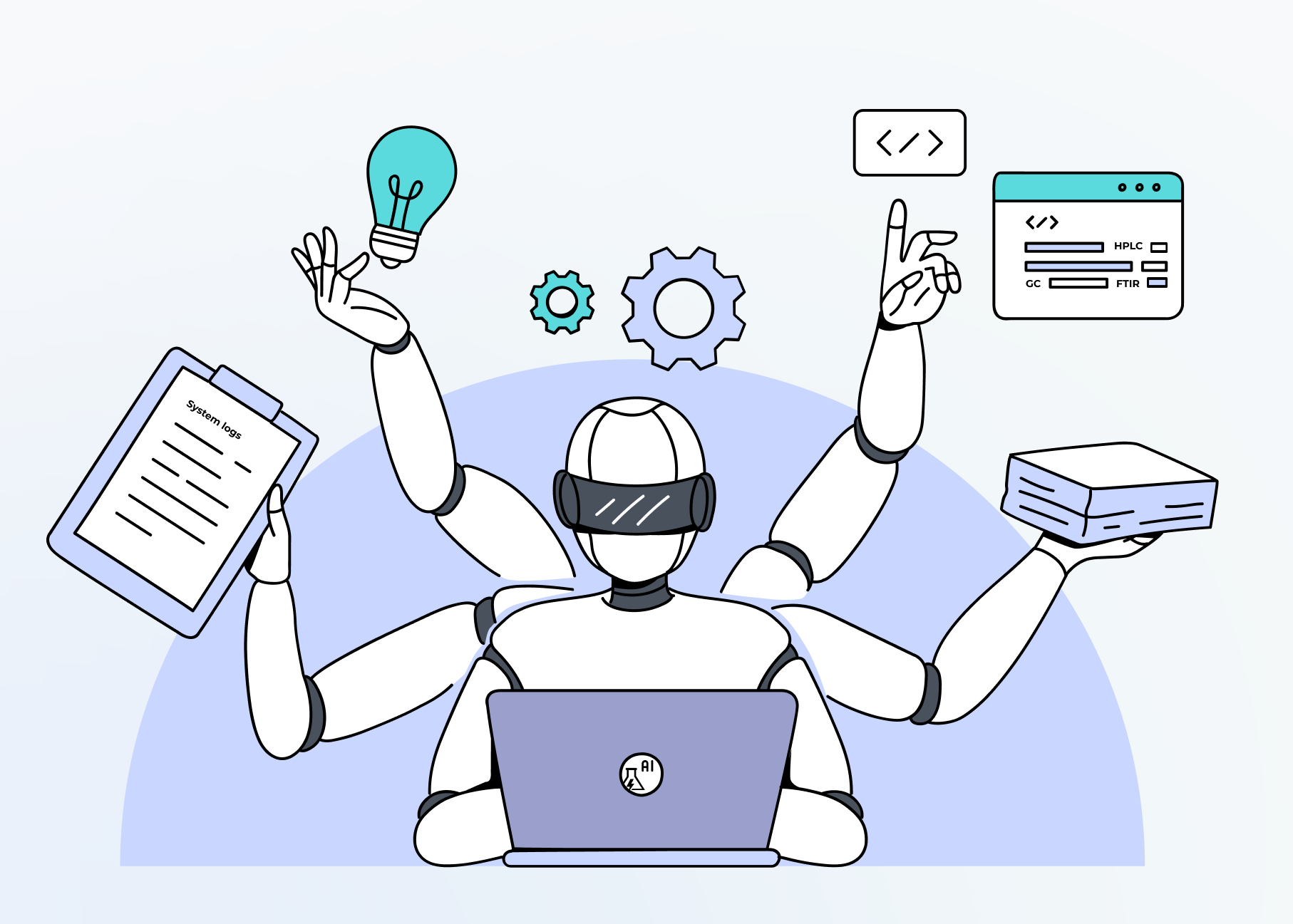
Why holistic knowledge management is the key to successful laboratory automation
.avif)
When Laboratory Automation Becomes More Complex Than Expected
Automation in the laboratory promises relief: fewer manual steps, higher throughput, and more reproducible results. That is true but it is only half the story.
What many laboratories only realise after implementation is that every automated process step also increases the complexity of the overall system. Robotic platforms, liquid handlers, automated incubators—each device becomes another link in the chain. And the longer that chain becomes, the more difficult it is to locate the source of an error.
The challenge with automation chains is that problems often only become visible at the end, even though they originated at the very beginning. An incorrectly calibrated dispenser in step two may not become apparent until the results from step eight are reviewed. Anyone who does not understand this connection—or does not know the equipment history—is left searching in the dark.
This is precisely where a new form of dependency arises. Not dependency on the technology itself, but on the people who understand it. The one employee who knows how the autosampler “really” behaves. The external service technician who is called when nothing works anymore. The laboratory instrument whose peculiarities have never been documented anywhere.
Laboratory digitalisation and laboratory automation are no longer a question of whether they will happen. The crucial question is: Can we manage the complexity we create in the long term using our own knowledge and resources?
What Knowledge Management in the Laboratory Really Means
When people talk about knowledge management in a laboratory context, most initially think of scientific data—measurement results, publications, and LIMS entries. That is understandable, but it does not go far enough.
There is a second level that is at least as important: operational knowledge. This is the knowledge generated through the daily use of equipment and processes. How does the liquid handler behave with certain viscosities? What caused the error last November? Who in the team has solved this problem before—and how?
SOPs and protocols cover this area only to a limited extent. They describe how a process should ideally be performed. What they do not capture is the reality of everyday laboratory work: the small adjustments that have become established over time, the faults someone learned from, and the lessons that were never written down.
The consequences are well known. Staff turnover creates knowledge gaps that are difficult to close. The shortage of skilled workers makes the problem even more severe. Departments work alongside one another instead of learning from each other. And somewhere in a cupboard lies a notebook that nobody can find anymore.
The central tool for operational knowledge management is the equipment logbook. It documents what has happened to an instrument—maintenance, repairs, abnormalities, and deviations in measurement results. In many laboratories, this logbook still exists on paper, if it exists at all.
A paperless laboratory that records this information digitally and in a structured way has a clear advantage: the complete equipment history is searchable and immediately accessible to every authorised user.
Why Operational Laboratory Management Is the Real Driver of Efficiency
An Automation Chain Is Only as Strong as Its Weakest Knowledge Link
That may sound like a cliché, but its impact is measurable.
When an instrument fails and nobody knows what was last done to it, diagnosis can take hours. When the same problem has occurred before and was properly documented, diagnosis may take only a few minutes.
Laboratories that can diagnose faults quickly require less external support. This does not only reduce the cost of service visits it primarily reduces downtime. In an automated laboratory designed for high throughput, such downtime is particularly expensive.
Onboarding and Resilience in the Face of Skills Shortages
Another effect that is often underestimated in practice is that systematic knowledge management significantly accelerates the onboarding of new employees.
Instead of relying on experienced colleagues for months, new team members can access documented experience and begin working independently much sooner.
This is not simply a matter of convenience. It creates strategic resilience. Laboratories that consistently build and maintain their knowledge base are less vulnerable to skills shortages not because they no longer need qualified people, but because their knowledge is no longer stored exclusively in the minds of individual employees.
Laboratory Management Software as a Knowledge System—not Just an Administrative Tool
When people think of laboratory management software, they usually think of inventory lists and maintenance deadlines. That is correct, but the potential goes much further.
A modern laboratory management platform can become the central knowledge base of a laboratory—provided it is designed to capture, structure, and make operational knowledge accessible.
Another aspect should not be overlooked: for laboratories seeking or already holding accreditation according to ISO/IEC 17025, traceable documentation is not optional. Equipment histories, calibration records, and process documentation are mandatory.
Laboratories that meet these requirements digitally and systematically do not only gain a compliance advantage. They also build a reliable knowledge base that provides value far beyond the accreditation process.
Independent or Dependent? A Strategic Decision
As laboratory automation advances, an operational issue becomes a strategic one: Do we accept permanent dependence on external specialists, or do we invest in knowledge sovereignty?
External dependency comes at a cost. Long response times when the service technician is not available until the following week. High costs for service visits that could have been avoided through better internal documentation. Production downtime that could have been prevented.
Centralised laboratory equipment management - with complete equipment histories, documented incidents, and recorded solutions - provides the foundation for greater independence.
This does not happen overnight. Knowledge sovereignty is the result of consistent, structured documentation in everyday operations over months and years.
Laboratories that begin building this foundation often notice the first benefits sooner than expected: the first time a problem is solved without calling external support, or the first time a new employee can answer a question independently.
[[image-1]]
How LabThunder Brings Knowledge Management into the Laboratory
The challenges described above are not isolated cases. They affect almost every laboratory that seriously invests in automation.
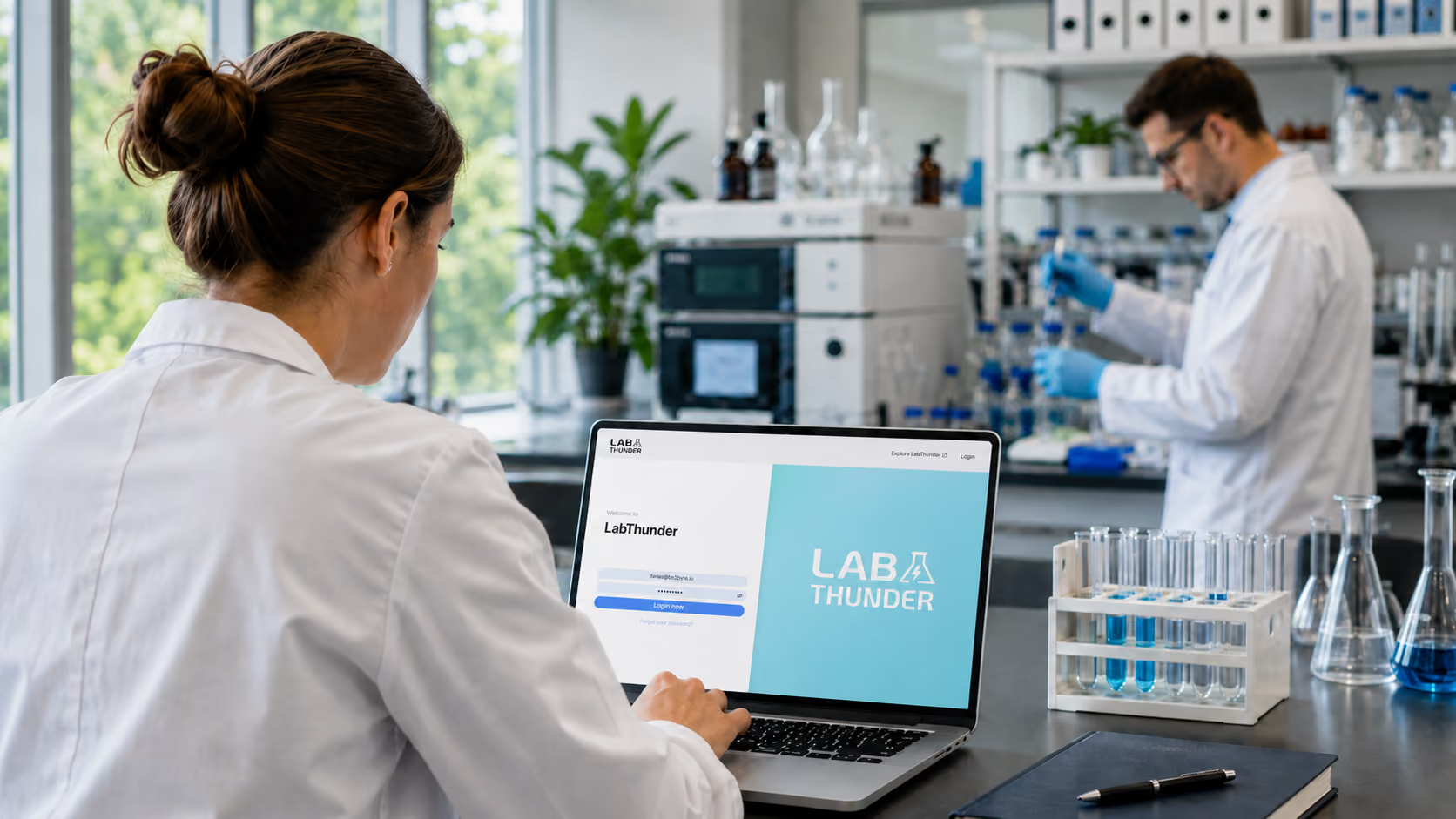
LabThunder is laboratory management software specifically designed to capture, structure, and make operational knowledge usable. Its approach is based on three consecutive stages.
Stage 1 - Capturing Knowledge in Daily Operations: Equipment Management
The foundation is digital equipment management.
Every maintenance activity, repair, and irregularity is recorded directly for the relevant instrument in a structured and centralised format. The digital equipment logbook makes the complete equipment history visible at a glance.
Errors within an automation chain can be traced back to their actual point of origin. There are no scattered paper notes and no need to search through old email conversations. This is where the paperless laboratory becomes a practical reality.
Stage 2 - Preserving and Sharing Knowledge: The LabThunder Wiki
In the second stage, knowledge is not merely collected. It is structured and made accessible across departments.
The integrated wiki enables teams to preserve best practices, troubleshooting experience, and process knowledge over the long term regardless of whether a particular employee is on holiday or has left the company.
Knowledge stored in individual minds becomes institutional knowledge. That is the difference between a laboratory that depends on individual people and one that is genuinely resilient.
Stage 3 - Activating Knowledge: Thunder AI as Contextualised Intelligence
In the third stage, Thunder AI makes the collected knowledge actively usable.
The AI can access information from all modules, including logbooks, the wiki, and equipment data. It does not provide generic answers. Instead, it delivers contextualised information based on the actual equipment history and the documented experience of the laboratory’s own team.
It works like a virtual service technician available 24 hours a day and supported by the specific knowledge of the laboratory itself.
Automation Without Knowledge Management Is Incomplete
Laboratories that automate processes without preserving knowledge merely shift their dependencies they do not eliminate them.
The dependency on manual process steps may disappear. The dependency on external service technicians remains, or may even increase.
Operational knowledge management is not an IT project that is completed once and then forgotten. It is a strategic decision that strengthens the laboratory’s long-term viability.
Its impact can be measured through reduced downtime, faster onboarding, lower service costs, and greater independence.
Anyone who would like to see what this looks like in practice can book a LabThunder demo and experience how fragmented laboratory knowledge can be transformed into a genuine knowledge system.
Frequently Asked Questions About This Topic
What does knowledge management have to do with laboratory automation?
More than many initially think. The more automated a laboratory becomes, the harder it is to locate and fix errors—without documented knowledge of devices, processes, and past incidents. Operational knowledge management is the prerequisite for ensuring that an automation chain remains stable and manageable in the long term.
What is the difference between operational and scientific knowledge management?
Scientific knowledge management focuses on research data, measurement results, and publications—the domain of LIMS and similar systems. Operational knowledge management goes a level deeper: it concerns the knowledge generated through the daily use of equipment and processes. How does a specific device behave under certain conditions? What was the root cause of an error—and how was it resolved? This knowledge often resides in the minds of individuals and is lost when staff turnover occurs.
Why are SOPs and protocols not enough?
SOPs describe the ideal scenario. They dictate how a process should run not what happens when it doesn't. Operational knowledge is born precisely in that gap: from the experiences, adjustments, and problem-solving that never make it into an SOP. Relying solely on protocols documents the theory, but misses the reality of day-to-day lab life.
How do knowledge management and ISO 17025 accreditation relate to each other?
ISO 17025 laboratory accreditation requires that processes and equipment data be documented in a traceable manner. By consistently managing operational knowledge—maintaining complete equipment histories, calibration logs, and structured process records—these requirements are met not as an additional burden, but as a natural byproduct of daily work.
At what level of automation does structured knowledge management become worthwhile?
Early on. As soon as more than one device interacts in an automated process, complexity arises that becomes nearly impossible to manage without documentation. By starting to capture knowledge early, you build a knowledge base that grows alongside your level of automation—rather than having to retroactively close a gap that has widened over the years.
How long does it take for a laboratory to benefit from structured knowledge management?
The first results appear faster than expected. Often, this happens the moment an internal problem is solved that would have otherwise required a service technician or when a new team member can answer a question on their own because the information is already documented. The strategic benefits resilience, self-sufficiency, and faster onboarding build up over months and grow in proportion to the consistency of your documentation.

.avif)