
Laboratory Knowledge Management
.avif)
The Path to Greater Efficiency, Lower Costs, and Less Frustration
In times of skilled labor shortages, complex equipment technology, and rising price pressure, many laboratories face a quiet but far-reaching challenge: knowledge is being lost. Every day.
We recently ran a survey among lab professionals on LinkedIn. Over 266 people took part – with a clear result: More than 80 % of respondents said their lab depends in some way on the knowledge of individual people. Over 50 % rated this dependency as "very strong".
These numbers reflect a trend that has been running through the entire lab landscape for years. The causes are varied – and they reinforce one another:
- Technological development is advancing rapidly: devices are becoming more complex, software solutions more powerful, and operation more demanding.
- The shortage of skilled workers keeps intensifying. Well-trained staff are hard to find – and even harder to keep.
- Time for structured onboarding or systematic training is often lacking in day-to-day operations. New colleagues learn by the "Learning by Asking" principle – if at all.
In this mix, labs are increasingly falling into a dangerous dependency – not on technology, but on individual people whose experience has become priceless – and, at the same time, invisible.
What happens when these people are unavailable? An analysis no longer takes hours, but days. Errors aren't resolved, they're passed along. And issues that could actually be fixed in minutes lead to costly downtime or unnecessary service calls.
Missing knowledge has concrete consequences in the lab environment:
- Delayed turnaround times
- Costly downtime
- Poor decisions
- New employees feeling overwhelmed
- And in the worst case: risks to patients or research results
The problem doesn't lie in employees' commitment – it lies in a system that secures no knowledge, documents no learning, and offers no structure to make experience usable.
[[image-1]]
The Hidden Costs of Knowledge Gaps
Knowledge gaps in the lab don't set off loud alarms. But in the background, they act like a slow-acting poison: they slow down processes, tie up resources, and drive up costs.
A device shows an error message, but no one knows how to handle it. Instead of acting decisively, a frustrating search for information begins – through old logs, dusty folders, or the one person on the team who "has seen this before". If that person is unreachable, operations grind to a halt.
Situations like this lead to unnecessary service calls. Problems that could be solved internally turn into costly outsourced work orders. An on-site service visit can quickly cost several thousand euros – not counting the lost time and productivity.
Without structured knowledge, onboarding new employees takes weeks, sometimes months. The less documented experiential knowledge there is, the greater the dependency on long-tenured colleagues – with corresponding overload.
On top of that: without clear standards and accessible experience-based knowledge, operating errors creep in. Analyses have to be repeated or discarded. In regulated environments such as the pharmaceutical industry, this can become a real problem.
Knowledge Management – A Trend with Substance
More and more companies are investing specifically in knowledge management systems. What used to be seen as an organizational side note is now a strategic success factor. In a world of high turnover and complex processes, structured knowledge transfer has become a matter of survival.
Labs should actually be taking the lead here. Few environments are as technology-driven and as dependent on the know-how of experienced users. Modern automation doesn't remove the need for understanding – on the contrary, it makes it even more important.
And this is exactly where the problem lies: When no one knows how to use the technology properly anymore, even the best technology is useless.
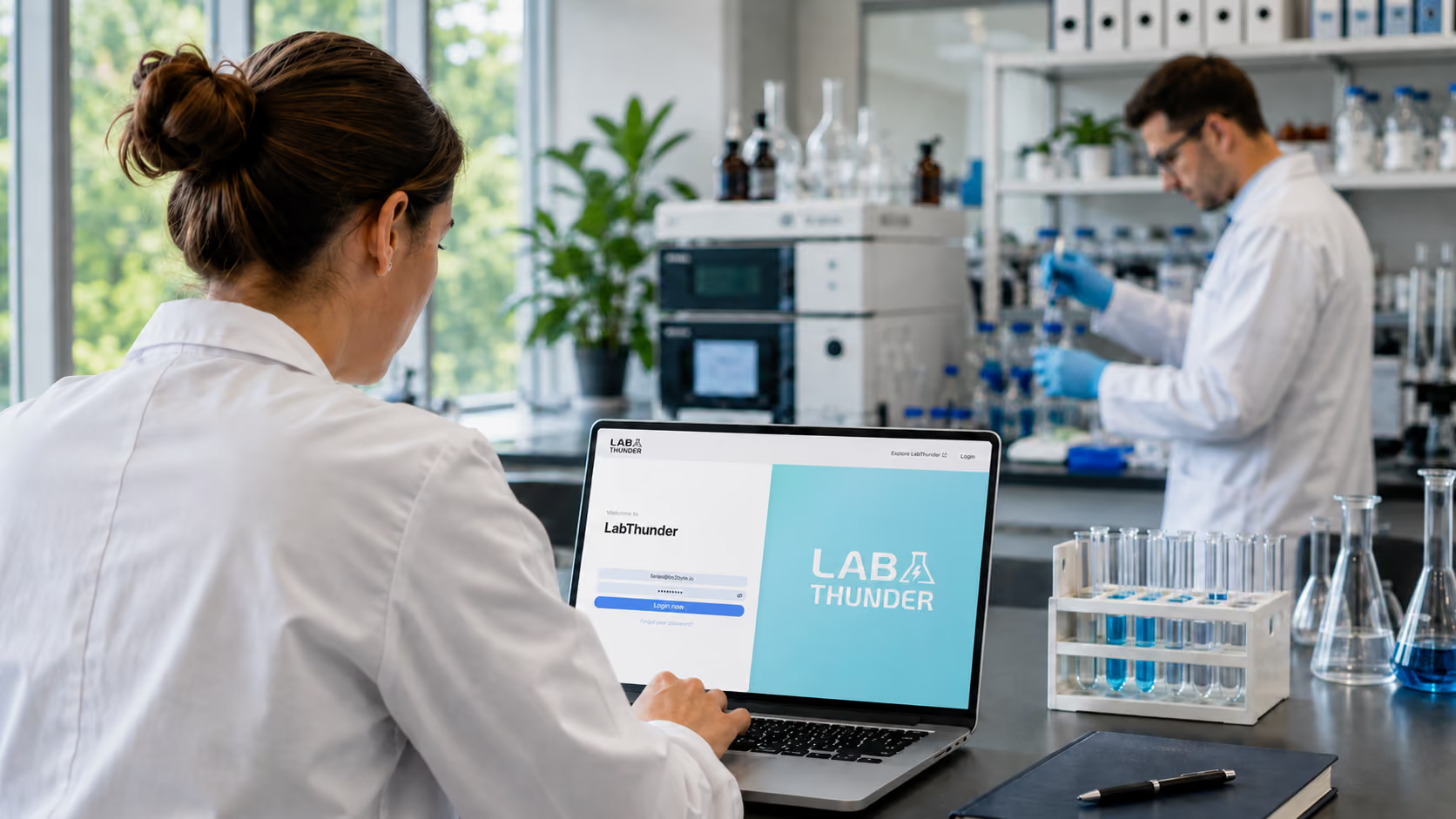
A typical example: Christian stands at a loss in front of a GCMS system. An error code flashes on the display. He's holding the device manual – but it doesn't help. The colleague who knows this error is on vacation. The result: downtime, frustration, a service call. Yet the solution was already known – it just couldn't be found.
[[image-2]]
The Hidden Costs of Knowledge Gaps
Knowledge gaps in the lab don't set off loud alarms. But in the background, they act like a slow-acting poison: they slow down processes, tie up resources, and drive up costs.
A device shows an error message, but no one knows how to handle it. Instead of acting decisively, a frustrating search for information begins – through old logs, dusty folders, or the one person on the team who "has seen this before". If that person is unreachable, operations grind to a halt.
Situations like this lead to unnecessary service calls. Problems that could be solved internally turn into costly outsourced work orders. An on-site service visit can quickly cost several thousand euros – not counting the lost time and productivity.
Without structured knowledge, onboarding new employees takes weeks, sometimes months. The less documented experiential knowledge there is, the greater the dependency on long-tenured colleagues – with corresponding overload.
On top of that: without clear standards and accessible experience-based knowledge, operating errors creep in. Analyses have to be repeated or discarded. In regulated environments such as the pharmaceutical industry, this can become a real problem.
Knowledge Management – A Trend with Substance
More and more companies are investing specifically in knowledge management systems. What used to be seen as an organizational side note is now a strategic success factor. In a world of high turnover and complex processes, structured knowledge transfer has become a matter of survival.
Labs should actually be taking the lead here. Few environments are as technology-driven and as dependent on the know-how of experienced users. Modern automation doesn't remove the need for understanding – on the contrary, it makes it even more important.
And this is exactly where the problem lies: When no one knows how to use the technology properly anymore, even the best technology is useless.
A typical example: Christian stands at a loss in front of a GCMS system. An error code flashes on the display. He's holding the device manual – but it doesn't help. The colleague who knows this error is on vacation. The result: downtime, frustration, a service call. Yet the solution was already known – it just couldn't be found.
How AI Helps Make Knowledge Available
Manufacturers provide extensive manuals, and there are videos, databases, websites. But in practice, access at the critical moment is often missing. The information is scattered, hard to search, often only in English – and not integrated into everyday work.
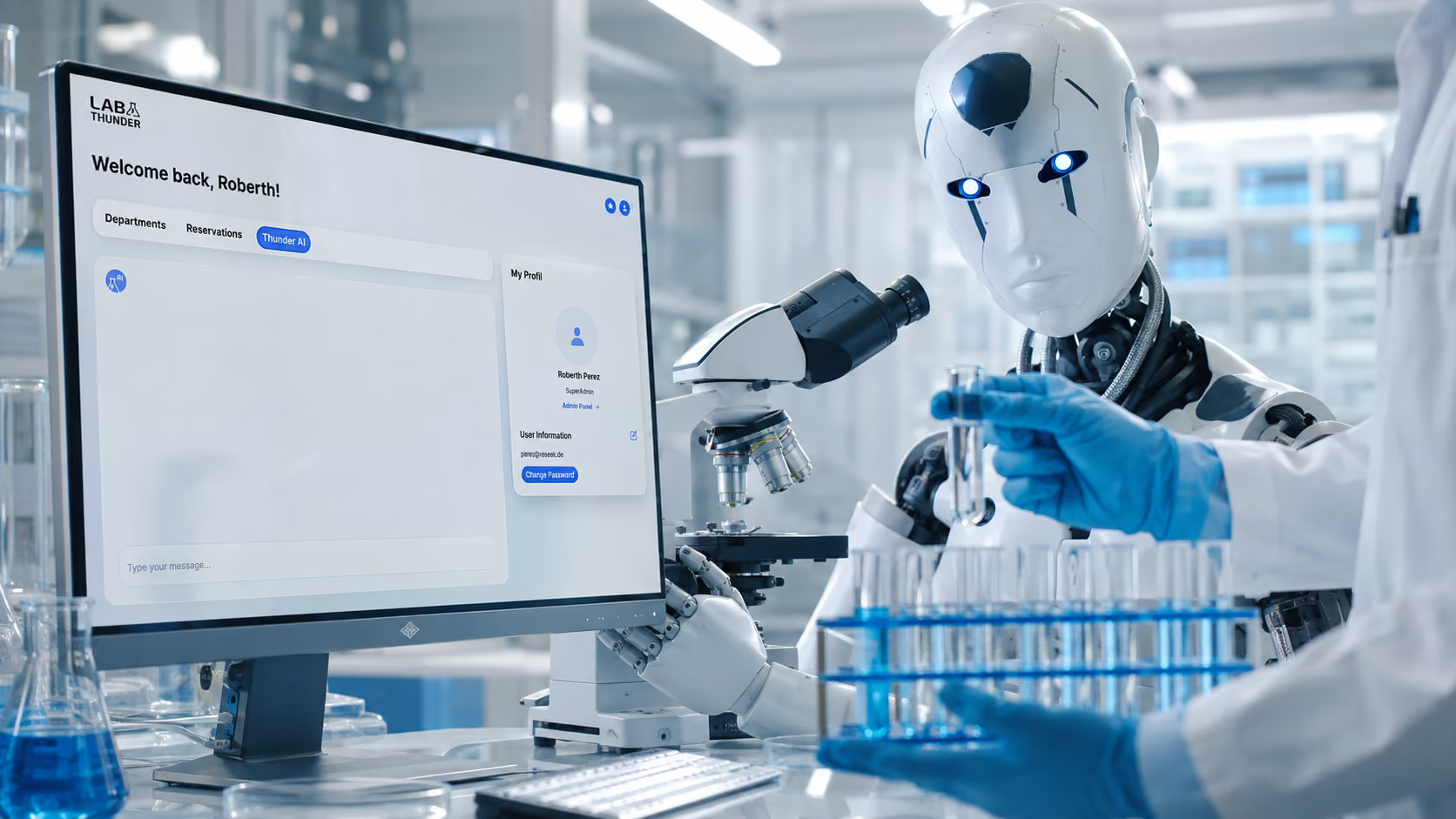
This is where artificial intelligence (AI) comes in. Modern systems automatically analyze technical documents, training materials, and logbooks, delivering relevant information exactly when it's needed. Early approaches – such as AI-powered PDF search – are already showing results.
Solutions like LabThunder® with its Thunder AI™ module go even further: they combine structured knowledge management with intelligent analysis, error detection, and language processing.
The AI reads manuals, training notes, and operating logs, links content to error codes and devices – and delivers the right information: in the right language, in the right context, at the right time.
The goal isn't to replace experience – it's to make it findable and usable. So that knowledge works where it's needed.
Conclusion: Preserving Knowledge Means Securing the Future
The lab world is under pressure: rising complexity, skilled labor shortages, quality requirements. At the same time, valuable experiential knowledge disappears every day – quietly, but with real consequences.
Building a digital knowledge management system, supported by AI, isn't a vision for the future – it's a concrete answer to a real problem.
LabThunder® helps make knowledge permanently usable, ease onboarding, minimize downtime, and take the pressure off employees. Because:
A lab that preserves knowledge gets better with every experience. A lab that forgets pays twice – in time, money, and quality.
If you'd like to find out how LabThunder® can help your lab too, I'd be glad to talk.
Häufige Fragen zum Wissensmanagement im Labor
Why Is Knowledge Lost in the Laboratory?
Knowledge is lost in laboratories because practical experience often exists only in the minds of individual employees. A shortage of skilled professionals, increasingly complex equipment, and insufficient time for structured onboarding make the problem even worse. According to a LinkedIn survey of 266 laboratory professionals, more than 80% of laboratories depend on the knowledge of individual employees—with over 50% reporting that they are “highly dependent.”
How Much Do Knowledge Gaps Cost in the Laboratory?
Knowledge gaps lead to delayed turnaround times, costly equipment downtime, and unnecessary service calls. A single on-site service visit can cost several thousand euros often for issues that could be resolved internally within minutes if the relevant knowledge were documented and easy to find. In addition, onboarding new employees can take weeks or even months.
How Does AI Help with Knowledge Management in the Laboratory?
AI automatically analyzes technical documents, manuals, training materials, and logbooks, providing relevant information at the right moment. Systems such as Thunder AI™ in LabThunder® link content to error codes and equipment, delivering the right answer—in the right language, in the right context, at the right time.
Does AI Replace the Experience of Laboratory Professionals?
No. The goal of AI-powered knowledge management is not to replace experience, but to make it easy to find and use. The expertise of long-standing employees is documented and made accessible to the entire team—even when the person is on vacation or leaves the laboratory.
What is LabThunder®?
LabThunder® is laboratory management software that combines digital knowledge management with AI. Modules such as Thunder AI™ make equipment knowledge, troubleshooting solutions, and practical experience permanently accessible reducing downtime, accelerating onboarding, and relieving the workload of experienced employees.

.avif)
.avif)