
Two standards, one goal: quality and competence in the lab under ISO 17025 and ISO 15189

Introduction:
why two international standards pursue the same goal
Introduction: why two international standards pursue the same goal
Picture this: an environmental lab measures the temperature of a water sample at exactly 23.4 °C. At the same time, a medical lab determines a patient's body temperature - also at 23.4 °C (hypothetically, for comparison's sake). Two completely different contexts, two different standards - and yet the same requirement: the result must be absolutely reliable.
Modern laboratories - whether testing, calibration, or medical facilities - face the same challenges: reliable results, clear traceability, audit-ready documentation, and robust quality management. While their tasks differ fundamentally, ISO 17025 (testing and calibration laboratories) and ISO 15189 (medical laboratories) are built on identical core principles: competence, validity, traceability, transparency, and continuous improvement.
Both standards share the same overarching goal: producing results that patients, customers, and regulatory authorities can rely on. This article shows where the two standards converge, where they diverge - and how modern digitalization brings both worlds together.
ISO 17025 vs. ISO 15189 - scope of application and target audiences
ISO 17025 / DIN EN ISO/IEC 17025
Applies to: testing and calibration laboratories
Focus: technical competence, measurement uncertainty, equipment management
Typical areas: environmental analysis, materials testing, physical and chemical measurements
The standard places strong emphasis on:
- Traceability to SI units (§ 6.5 / § 6.6)
- Requirements for equipment and instruments (§ 6.4 Equipment)
- Validity and repeatability of results
Practical example: A calibration lab for industrial scales must be able to demonstrate that every weight measurement is traceable to the international kilogram standard - with a documented calibration chain through national metrology institutes down to the SI unit.
ISO 15189 / DIN EN ISO 15189
Applies to: Medical laboratories
Focus: Patient care, result validation, pre- and post-analytical processes
Incorporates ISO 9001 elements more heavily
Alongside technical competence, a particular emphasis is placed on:
- clinical responsibility
- Result interpretation
- Quality of patient care
Practical example: A clinical lab measures a diabetic patient's HbA1c level. This isn't just about the technical precision of the measurement, but also about correctly interpreting it in a clinical context - was the sample collected correctly? Is the result meaningful for the treatment decision? Was the patient properly prepared?
Shared quality principles
Despite their different target audiences, both standards are built on identical foundations. These commonalities are no coincidence - they reflect universal quality requirements that apply to any form of precise measurement.
1. Personnel competence
ISO 17025 § 6.2: Qualification for testing and calibration tasks
ISO 15189 § 7.2 / § 5.1: Professional competence for medical result reporting
Both require documented competencies, training, and regular effectiveness reviews.
In practice, that means: a lab technician operating a mass spectrometer must demonstrate their qualifications just as a medical laboratory assistant preparing blood counts must. Both need regular training, both undergo competence assessments - and both leave their signature in electronic systems that precisely document who performed which measurement and when.
2. Traceability - the core of both standards
Traceability means that every result can be clearly traced back to a valid reference - ideally SI units. This is the absolute foundation of both standards.
ISO 17025 § 6.5 / § 6.6: Traceability to national or international standards
ISO 15189 § 7.3.3: Traceability of clinical measurands
Why is this so critical? Imagine two labs measure the same sample - and arrive at different results. Without traceability to shared standards, there's no way to tell which lab is correct. In a materials test, that could lead to production defects. In a medical diagnosis, a human life could depend on it.
Concrete example: A thermometer is calibrated at the national metrology institute. That institute in turn traces its own measurements back to the international kelvin standard. Every temperature measurement in your lab can then be traced through this chain all the way to the SI base unit - with documented measurement uncertainty at every stage.
3. Documentation & data integrity
Both standards emphasize the need for audit-ready data. Four principles are central:
- Integrity: data must not be altered unnoticed
- Completeness: no gaps in documentation
- Protection against manipulation: changes must be traceable
- Audit trail: who changed what, when - and why?
Reality check: an auditor shows up at your lab and asks: "Show me the calibration history of the HPLC system from March 2023." Can you produce a complete, gapless record within 5 minutes? Both standards demand exactly that - and modern digital systems make it possible.
4. Quality management
Both standards mandate a complete QM system:
- Document control
- Corrective actions (CAPA)
- Continuous improvement
- Risk management
The difference from the "paper QM" of the past: it used to mean binders full of records nobody read. Today, it means smart workflows that automatically escalate when a device is overdue for calibration - before measurement errors occur.
Key differences at a glance
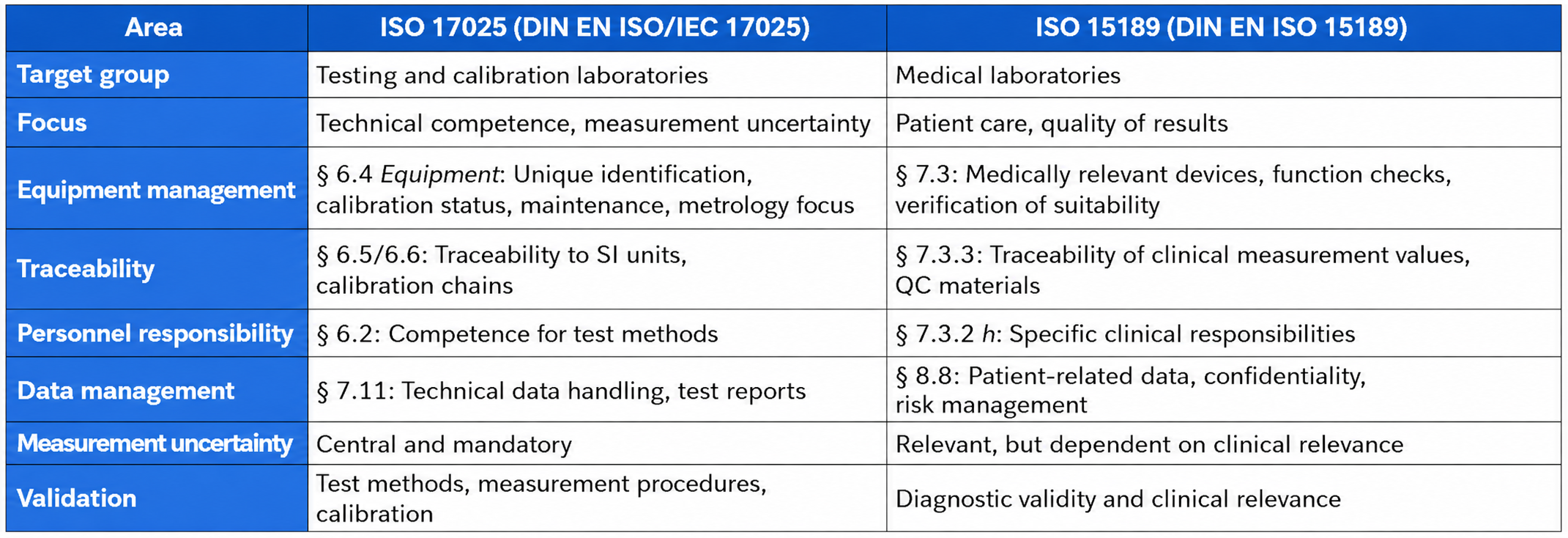
What truly connects both standards - the 6 pillars of quality
Regardless of the lab's mission, both standards pursue the same quality goals:
- Reproducible results - measurements must be repeatable
- Clear traceability of all measurements to recognized standards
- Secure equipment management - from commissioning to decommissioning
- Audit-ready documentation - always ready for review
- Risk and error reduction through preventive controls
- Clear accountability - no measurement without clear responsibility
This means ISO 17025 and ISO 15189 are much closer to each other than they appear at first glance. They are two dialects of the same quality language.
Equipment management as a shared key
Equipment is the foundation of every analytical measurement. A miscalibrated pipetting system, an overdue thermometer, or an analyzer without a maintenance history can all distort results. Both standards therefore define clear requirements:
1. Clear identification
Every device must be uniquely identifiable:
- Asset ID (e.g., "HPLC-001")
- Calibration status (currently valid, overdue, blocked)
- Location (Lab A, Room 3.14)
- Responsible person (Dr. Müller)
ISO 17025 § 6.4.2 requires clear identification of all testing equipment.
ISO 15189 § 7.3.2 requires a complete equipment file.
Practical scenario: An auditor enters your lab, points to an HPLC system, and asks: "When was this device last calibrated? Who performed it? Were there any deviations?" With digital identification (e.g., a QR code), you scan the device, and all the information appears on your tablet – in seconds.
2. Calibration and traceability
Every measurement must be traceably linked to SI units – whether it is mass, time, temperature, or volume.
The 7 SI base units:
- Meter (m) – length
- Kilogram (kg) – mass
- Second (s) – time
- Kelvin (K) – temperature
- Mole (mol) – amount of substance
- Ampere (A) – electric current
- Candela (cd) – luminous intensity
Practical example: A pharmaceutical company checks the volume of injection vials. The pipette used was tested with a calibrated reference volume. This reference volume, in turn, was certified by an accredited calibration laboratory that traces its measurement back to national standards. The entire chain is documented – from the vial to the SI unit "liter".
3. Maintenance and functional checks
Both standards require documented:
- Maintenance intervals (e.g., annual, semi-annual)
- Calibration cycles (based on manufacturer specifications or risk assessment)
- Functional tests (daily checks, e.g., temperature verification)
- Deviation management (What happens in the event of error messages?)
- Lock status for malfunctions (defective devices must not be used)
Real-world scenario: An incubator suddenly shows 38 °C instead of 37 °C. Without a system, this might go unnoticed. With digital device management, the deviation triggers an alarm, the device is automatically locked, and all measurements taken since the last successful check are flagged for review.
4. Device history & audit trail
To ensure auditors and QA managers can trace every action:
- What was changed? (Calibration certificate uploaded)
- When? (03/15/2025, 2:32 PM)
- By whom? (Dr. Schmidt)
- Reason for change? (Annual calibration according to maintenance schedule)
The difference between paper and digital: In a paper logbook, entries can be altered after the fact – and no one would know. A digital audit trail is immutable: every change is logged with a timestamp and user ID. This builds trust – with auditors, clients, and regulatory authorities.
Digitalization as a bridge – how modern laboratory software unites both standards
The requirements of ISO 17025 and ISO 15189 may seem complex on paper. In practice, many laboratories fail not because they don't understand the standards, but because of their efficient implementation. This is where digitalization comes in.
The challenge of the "paper lab"
Imagine a laboratory that still relies on Excel spreadsheets, paper logbooks, and manual reminders:
- A device is overdue for calibration – but no one noticed because the Excel list wasn't updated.
- An auditor asks for the maintenance history – and the team searches through three folders to pull together the relevant pages.
- A measurement needs to be traced – but the batch number of the reference material used was not recorded.
This isn't due to incompetence – it's the daily reality in many labs that haven't yet digitized. And this is exactly where modern laboratory software comes in.
Key areas that laboratory software must cover
1. Digital equipment management
- Centralized equipment files with all relevant information (manuals, certificates, service reports)
- Automatic calibration & maintenance reminders, before deadlines expire
- Traceability of all activities via audit trail
- Use of SI units for calibration with documented measurement deviation
2. Validated document control
- Electronic logbooks, which automatically capture timestamps and users
- Version control for SOPs and work instructions
- Automated reports for audits and management reviews
3. Integration with laboratory processes
- Linking equipment to specific measurements: Which device was used for which sample?
- Automatic plausibility checks: Was the device calibrated before the measurement?
- Real-time dashboards: Which devices are overdue? Where is action required?
Why an integrated solution makes the difference
Many laboratories work with multiple isolated systems: one software for equipment management, another for document control, and Excel for calibration deadlines. The result: Data silos, duplicate entries, and sources of error.
An integrated solution, on the other hand, connects all processes:
Example workflow in a digitized laboratory:
- A new HPLC system is delivered
- It is registered in the software (asset ID, location, person responsible)
- The maintenance schedule is created automatically (calibration every 12 months, functional check daily)
- The system sends a reminder 30 days before the deadline
- Calibration is performed and the certificate is uploaded digitally
- The device is automatically released for use again – and all subsequent measurements are linked to it
- During an audit, the entire history can be exported with a single click
This is not a vision of the future – it is already a reality in digitized laboratories.
LabThunder: A platform for both regulatory worlds
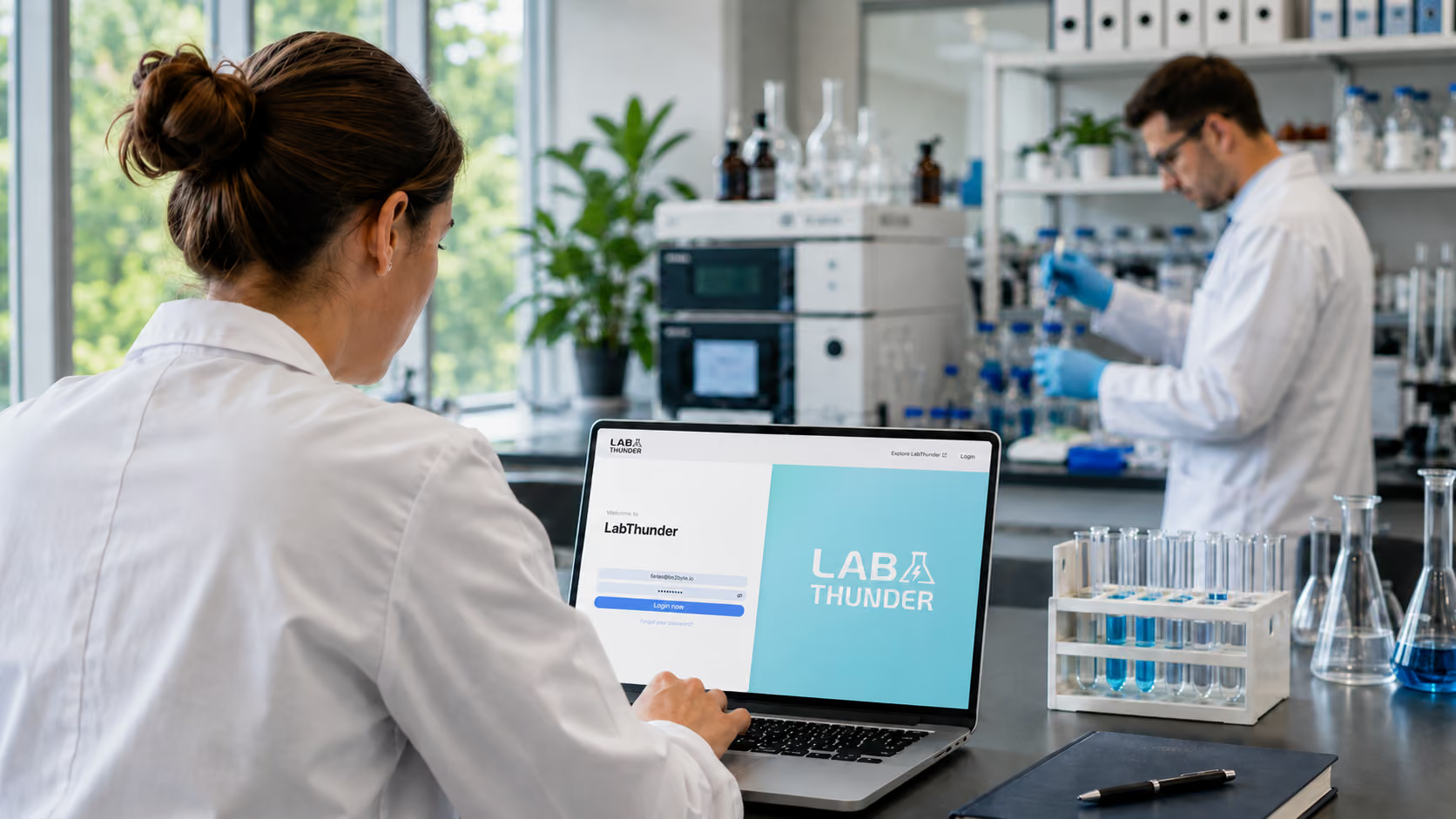
Digital solutions like LabThunder show how the requirements of ISO 17025 and ISO 15189 can not only be met, but implemented efficiently and error-free. The system was developed specifically for laboratory environments and combines:
- Digital test equipment management – central administration of all devices, tools, and measuring equipment
- Complete device histories – from commissioning to decommissioning
- Calibration tracking – automatic reminders, deadline management, certificate upload
- Digital logbooks – electronic records with audit trail
- Traceability of all activities – who did what and when?
- Role-based access management – not everyone is authorized to change everything
- Audit compliance for GxP, ISO, and medical standards
LabThunder covers all key requirements of both standards – from unique identification and maintenance to fully audit-ready process chains. Whether in an environmental laboratory or a clinic, the quality principles remain the same, and the software adapts to the specific context.
Conclusion: Two standards, one goal – quality, competence, and traceability
Even though ISO 17025 and ISO 15189 address different laboratory environments, they pursue the same goal: reliable results based on competent, traceable, and audit-compliant processes.
Both standards are built on the same pillars:
- Measurement competence – only qualified personnel perform measurements
- Traceability – every result can be traced back to recognized standards
- Robust equipment management – instruments are calibrated, maintained, and monitored
- Quality-assured processes – documented, validated, audit-compliant
The real question isn't whether your lab needs to meet these requirements – but how efficiently you meet them. Paper logs and Excel spreadsheets aren't wrong – but they are prone to errors, time-consuming, and difficult to audit.
By consistently digitizing your processes – especially through integrated software solutions – you can not only meet these requirements but implement them efficiently and in an audit-proof manner. Labs that take this step don't just gain time and security – they build the foundation for the excellent quality that patients, clients, and regulatory authorities rely on.
Because in the end, only one thing matters: the right result, at the right time, with complete traceability.
FAQ – ISO 17025 vs. ISO 15189
What is the most important difference between ISO 17025 and ISO 15189?
ISO 17025 is aimed at testing and calibration laboratories, focusing on metrological competence, measurement uncertainty, and technical validity. ISO 15189 is designed for medical laboratories and places additional, strong emphasis on patient care, pre- and post-analytical processes, and clinical evaluation. However, both standards are based on the same quality principles.
Do medical laboratories require ISO 17025 accreditation?
No. For medical laboratories, ISO 15189 is the relevant standard.
ISO 17025 only becomes relevant if a medical laboratory performs its own calibrations or metrological tests that must be demonstrably traceable.
What does traceability mean in both standards?
Traceability means that every measurement can be linked back to a recognized reference standard – ideally to SI units (e.g., kg, K, s, mol).
- ISO 17025 § 6.5 / 6.6: complete calibration records
- ISO 15189 § 7.3.3: clinically relevant traceability, QC materials
Do both standards require documented device management?
Yes. Both require clear identification, calibration and maintenance schedules, functional checks, and an audit-proof history.
- ISO 17025: § 6.4 Equipment
- ISO 15189: § 7.3
Digital equipment files significantly simplify audit readiness.
Must measurement uncertainty be calculated in both standards?
- ISO 17025: Yes, mandatory. Measurement uncertainty is a core requirement.
- ISO 15189: Yes, but context-dependent. It must be evaluated for clinically relevant parameters, but is less formally structured.
What role does electronic documentation play?
Both standards require a system that is:
- traceable,
- tamper-proof,
- version-controlled,
- auditable,
- and compliant with revision security standards.
Electronic logbooks and validated laboratory software meet these requirements more reliably than paper records.
Are audit trails mandatory in both standards?
Indirectly, yes.
While the standards do not explicitly use the term "audit trail," the requirements for data integrity, traceability, and change tracking effectively make such a system mandatory.
Why are SI units so important?
SI units (kilogram, meter, second, kelvin, etc.) form the common language of all measurements.
Only SI-traceable calibrations provide true international comparability and audit-ready traceability – both of which are essential for these standards.

.avif)